
Website preview · Bloomingdale Day Care & Nur Sch After School Program
Previewing at
Bloomingdale Day Care & Nur Sch After School Program logo973-838-2459Request a visit
Menu

World Emoji Day.

A look at why children hear our words differently, and what to say instead.

World Emoji Day

Share This Post

Parents say one thing; kids hear another. An article on Genmindful. com calls it a disconnect between our words and what children take in. Not jumping on the couch can land as an invitation to jump. A child's developing nervous system is still learning what words mean. Practice gives them the chance to learn in the moment.
? Be quiet! (You’re too much right now)

Shouting "be quiet" often makes a child louder. Instead, help your child use their voice with care rather than punishing what comes naturally. Try gesturing a volume dial, model quiet by playfully whispering, have them mirror your tone from loud to quiet, or play the quiet game. Each of these gives a child a concrete action to copy.

? Be careful! (The world is scary)

"Be careful" names a feeling, not an action. Children do better when you say what you want them to do: "Get down" or "Walk on the sidewalk. " You can also ask a question: "What do we need to do before we cross the street? " That question asks your child to notice the world and their own place in it.

? Stop crying! (It’s unsafe to show emotion)

Consider Instead: Help your child “name it to tame it” and “feel it to heal it.” Let them know, “I see you’re sad, and I’m here for you.”

? You’re being too emotional! (My feelings are wrong)

"You're being too emotional" tells a child their feelings are wrong. Instead, pause and notice your own triggers as a parent while staying curious about your child's experience. Validate the emotion, hold space for it, and make it safe to feel. Children calm down when they know the feeling is allowed.

? You make me so mad! (You’re responsible for other’s feelings)

"You make me so mad" hands a child responsibility for your feelings. Use an "I" statement instead: "I feel frustrated when I see the cat get hit because he could get hurt. " Boundaries that are consistent and discussed ahead of time make the wanted behavior easier. When children feel safe, powerful, and connected, they play on the same team.

What this looks like in practice

In a childcare room, these ideas look like ordinary moments. A teacher might crouch to a child's eye level and say what to do rather than what to stop. Another might gesture a volume dial when the room gets loud. Children practice naming feelings during play, then practice them again at home. Parents can expect to see teachers model the words and give children time to try them.

The benefit shows up at home, not overnight. A child who hears "walk on the sidewalk" instead of "be careful" starts to know the step itself. A child who hears "I see you're sad" learns to say sad on their own. These small shifts take repetition and patience. They build a child's awareness of themselves and the world, one everyday moment at a time.

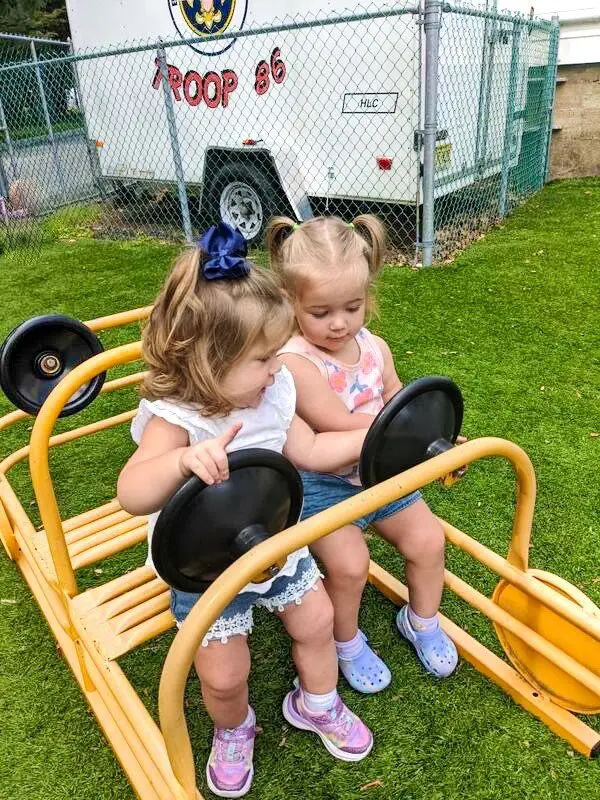
Two young girls sit together on a yellow playground glider with black steering wheels on green artificial turf, with a white trailer labeled 'TROOP 86' behind a chain-link fence.

Questions? Ask us

BD
Hi! I'm Bloomingdale
How can I help you today?
BD
Bloomingdale Day Care & Nur Sch After School Program Assistant
Ask about tours, programs, and enrollment.
Hi! I can help with Bloomingdale Day Care & Nur Sch After School Program questions.
Powered by EnrollIQ